
Traditional Scaffolding
At Globe Cambridge, we specialise in traditional scaffolding solutions for a wide range of residential, commercial, and industrial projects. With decades of combined experience…
Explore Traditional Scaffolding



Accredited & certified
Our quality, environmental and health and safety management systems are independently certified, and we hold the contractor accreditations main contractors ask for.
 ISO 9001 - Quality Management
 ISO 14001 - Environmental Management
 ISO 45001 - Health & Safety
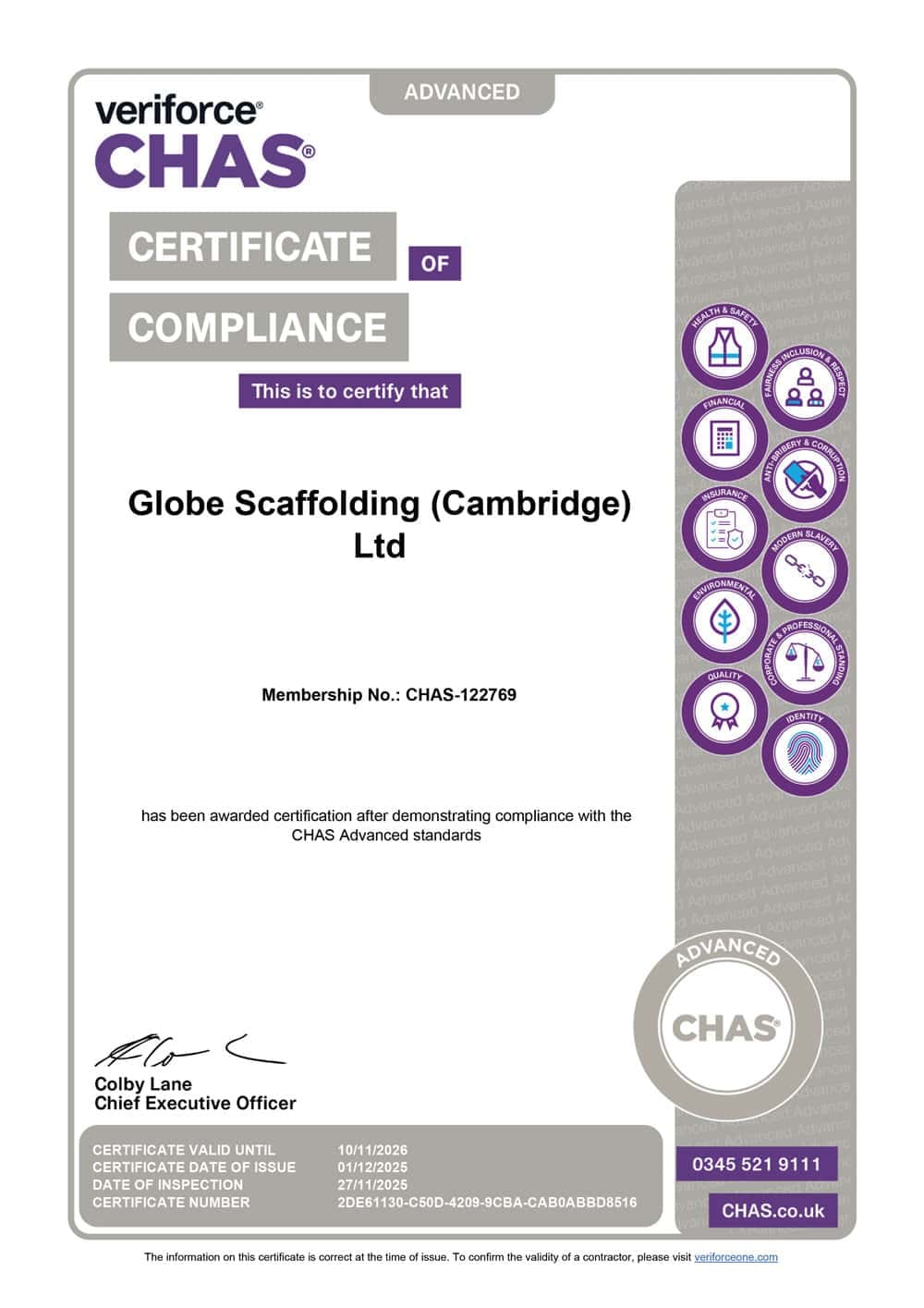 CHAS Advanced
 Constructionline Gold
 Builders Profile
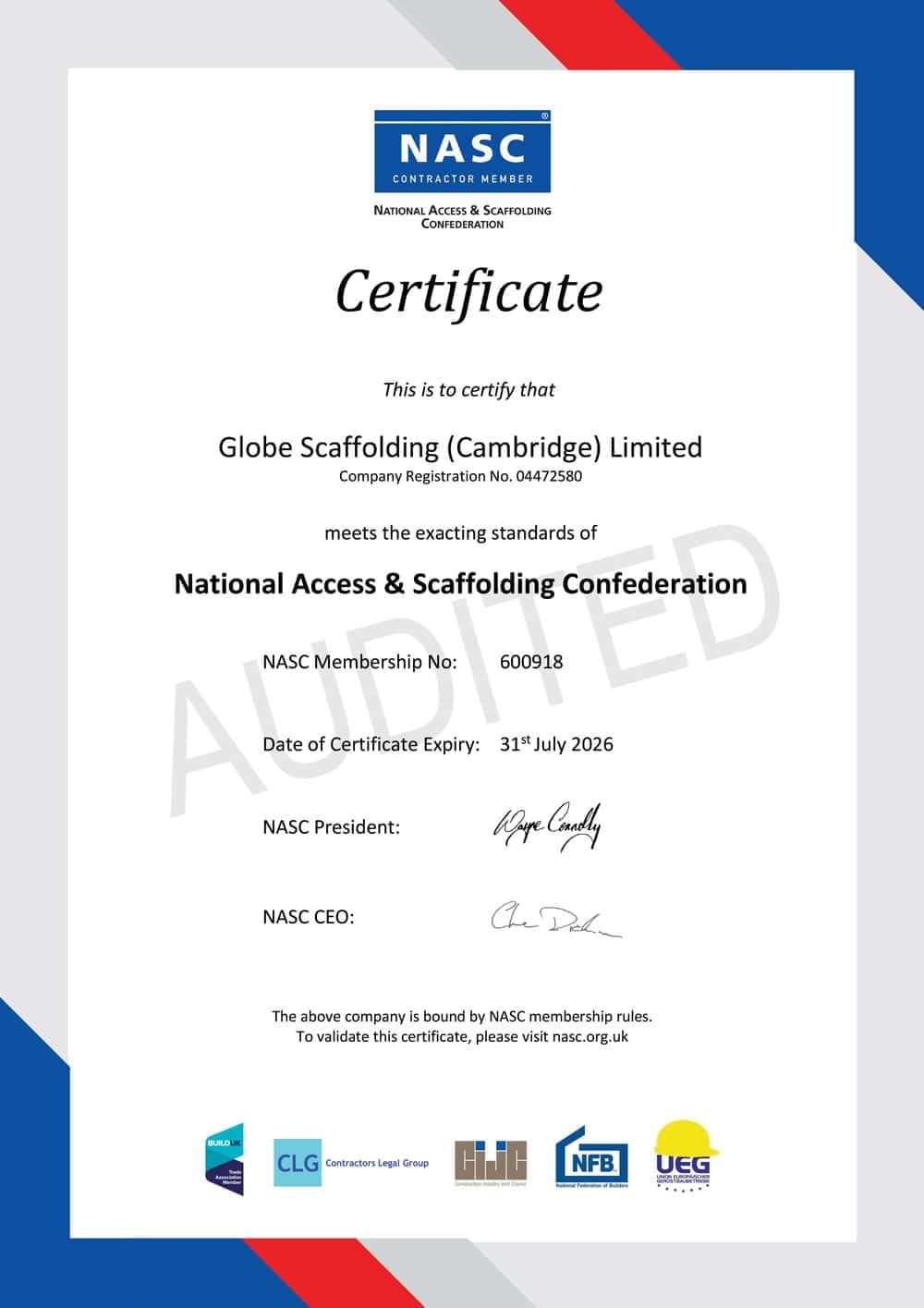 NASC Full Member
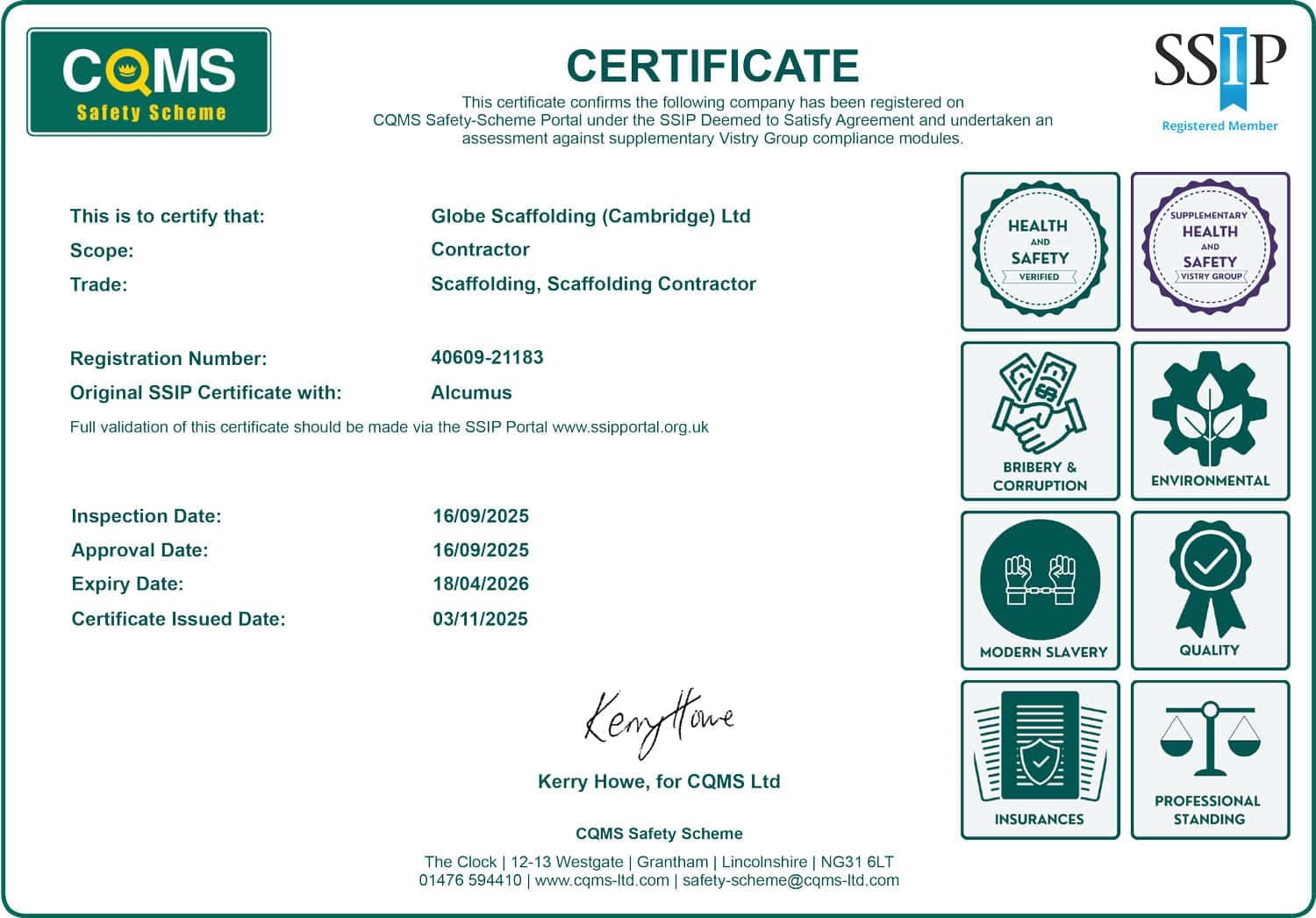 CQMS DTS Vistry CSR
What we do
Independent commercial scaffolding contractor based near Cambridge, working across Cambridgeshire and the South East on commercial, industrial, residential and public sector projects.
At Globe Cambridge, we specialise in traditional scaffolding solutions for a wide range of residential, commercial, and industrial projects. With decades of combined experience…
Explore Traditional Scaffolding

At Globe Cambridge, we offer advanced system scaffolding solutions for construction projects that demand speed, consistency, and strength. Ideal for large-scale commercial and…
Explore System Scaffolding

At Globe Cambridge, we provide high-quality temporary roof scaffolding to safeguard your site from wind, rain, and weather delays. Whether you’re carrying out a loft conversion, a…
Explore Temporary Roofs

At Globe Cambridge, we supply and install high-performance safety netting to protect workers, contractors, and the public from falls and falling objects on construction sites…
Explore Safety Netting

Globe Cambridge provide a full range of fall prevention systems to help protect workers operating at height. Designed to stop falls before they happen, our solutions support…
Explore Fall Prevention Systems

We can provide robust and compliant fall arrest systems that protect workers from serious injury if a fall occurs. Installed by our experienced team, these systems are an…
Explore Fall Arrest Systems

Scaffolding provides vital access for your construction project - but it can also create an easy route into your property for opportunistic thieves or trespassers. That’s why…
Explore Scaffold Alarms

We don’t just erect scaffolding - we engineer it. Our design, drawings, and calculation service ensures your scaffold structure is safe, compliant, and fit for purpose, no matter…
Explore Design Drawings and Calculations
About us
With over 30 years’ industry experience, Globe Scaffolding (Cambridge) Ltd is one of the most highly respected independent scaffolding contractors operating in Cambridgeshire & the South East.
Globe have an enviable reputation for the quality of our work, Health & Safety and for consistently providing innovative access solutions to meet our client’s requirements.
From initial design and advice to providing a reliable and high standard of service to many of the main construction companies in the UK.
Globe Scaffolding (Cambridge) Ltd works extensively across the commercial, industrial, residential and public sectors.
Projects

Globe Scaffolding Cambridge Ltd were appointed to deliver comprehensive scaffolding and access solutions for the Eddington Development in North West Cambridge — a large…
Read the case study
Insight
Practical guidance on scaffold planning, design, inspection and safety, written for developers, contractors and QSs.

On any scaffold of meaningful height, moving materials up and down efficiently makes a significant difference to the productivity of the trades using the platform. Bricks, mortar…

Every scaffold on a UK construction site is designed for a specific set of loads. Working platforms are rated for particular categories of use. Ties are engineered for particular…

Edge protection on a UK construction site is the visible part of the work-at-height safety system. Where it is well executed, it forms a consistent perimeter around every elevated…
Complete the form and one of the team will be in contact.