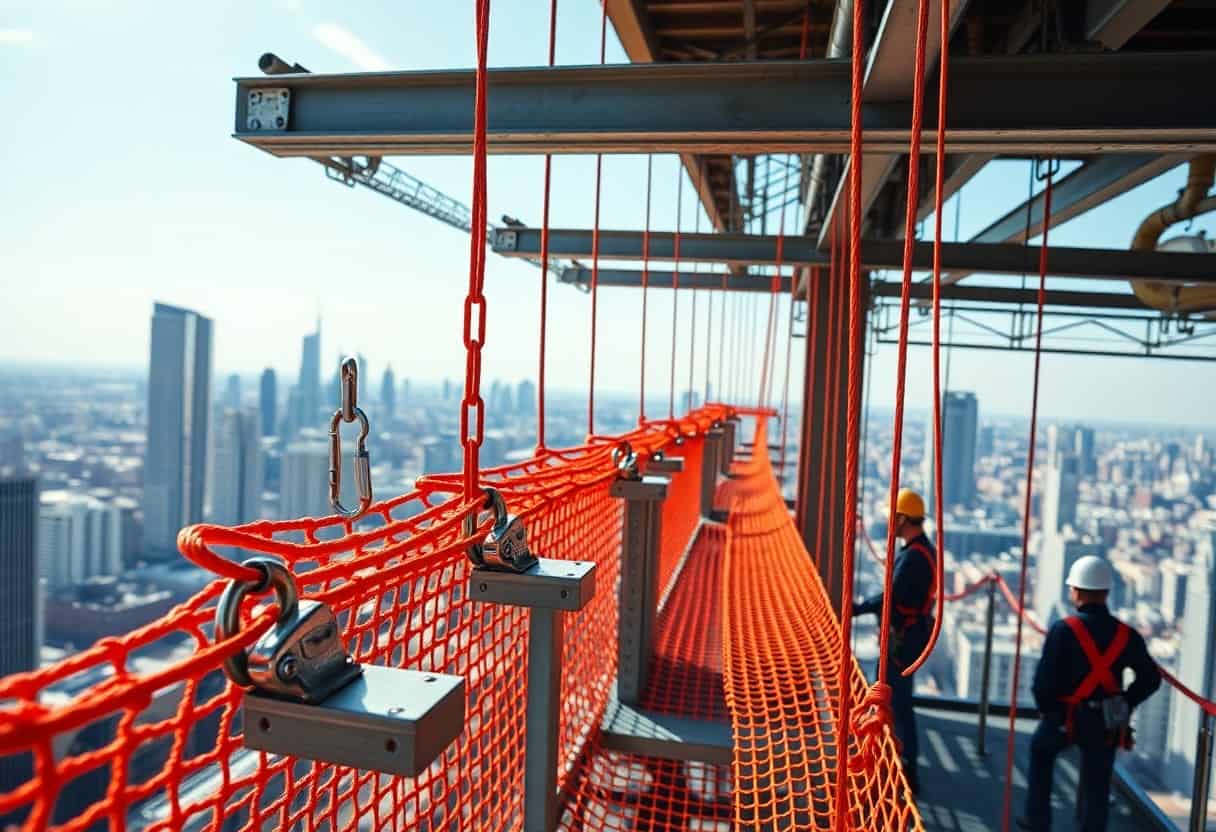
Netting provides a robust safety layer beneath elevated work, while fall-arrest systems secure you during unexpected slips; together they mitigate the risk of fatal falls and severe injuries, giving your team life‑saving protection and ensuring compliance with site regulations. You must select, install and inspect systems to match task-specific hazards, train your workforce, and maintain equipment so that your controls remain effective under changing site conditions.
Understanding Safety Netting
Definition and Purpose
You deploy safety netting beneath work areas to arrest falls and catch debris, spreading impact forces to reduce injury risk; nets are commonly fitted under scaffolds, roofs and openings and are tested to EN 1263-1 standards for dynamic performance. Manufacturers specify allowable drop mass and height, and you must ensure nets are tensioned and anchored per design to perform as intended. Assume that you check certification and inspection records before every installation.
- safety netting
- fall arrest
- EN 1263-1
- inspection
- installation
| Purpose | Arrest falls, catch debris, protect below |
| Standard | EN 1263-1 (performance/testing) |
| Typical locations | Under scaffolds, roof edges, openings |
| Protection type | Dynamic energy absorption, load distribution |
| Inspection | Pre-use checks daily; formal inspection per manufacturer |
Types of Safety Netting
You will encounter several classes: suspended nets for multi-storey catches, debris nets to stop falling tools and materials, perimeter nets at edges and energy-absorbing nets designed specifically for fall arrest. Mesh apertures commonly vary from 25-100mm and materials such as high-tenacity polyethylene offer UV resistance; life expectancy often ranges 5-10 years depending on exposure. Assume that you select type and rating based on task, drop scenario and workforce below.
- suspended nets
- debris nets
- perimeter nets
- energy-absorbing nets
- material
| Suspended net | Catches falls beneath working decks |
| Debris net | Contains tools, rubble and materials |
| Perimeter net | Installed at edges for lateral protection |
| Energy-absorbing net | Engineered to arrest personnel falls |
| Materials | HDPE/UV-stabilised synthetics, steel components |
You should note anchor spacing commonly falls between 1.5-3m depending on design and load, and allowable sag/clearance beneath the net is specified by manufacturers to control deceleration distances; contractors often mandate daily visual checks and formal inspections every 3-6 months. Equipment labels state maximum drop mass and test standard references. Assume that you log inspections and follow manufacturer limits for anchors, span and replacement intervals.
- anchor spacing
- allowable sag
- inspection interval
- maximum drop mass
- manufacturer limits
| Material | HDPE or similar, UV-stabilised |
| Mesh size | 25-100mm typical |
| Anchor spacing | Commonly 1.5-3m per design |
| Service life | Often 5-10 years, variable by exposure |
| Inspection | Daily pre-use + formal checks every 3-6 months |
Fall-Arrest Systems Explained
When you install a fall-arrest system, it must stop a fall safely and limit forces transmitted to the body; modern setups use harnesses, connectors and energy absorbers to restrict arresting forces to around 6 kN and require anchorages designed to withstand at least 12 kN. You should check product datasheets and suppliers such as EDGE Fall Protection: Edge Safety & Fall Protection Solutions … for system ratings, certified testing and application guidance before selecting equipment.
Key Components of Fall-Arrest Systems
You rely on a certified full‑body harness (EN 361), connectors (EN 362), energy absorbers or lanyards (EN 355) and secure anchor points; self‑retracting lifelines (SRLs) can limit free fall to under 1 m, while energy‑absorbing lanyards typically add 1-2 m of elongation. Also inspect stitching, webbing and corrosion‑resistant fittings, and note most harnesses are rated for users up to around 140 kg including tools.
Choosing the Right Fall-Arrest Equipment
You must match equipment to task: for mobile operatives an SRL reduces fall distance, while fixed work often uses lanyards with energy absorbers; assess fall factor, anchorage strength, duration of use and environment (salt, chemicals, heat). Prioritise compatibility, manufacturer compatibility charts and documented inspection records to ensure safe, compliant selection.
For example, calculate minimum fall clearance before you deploy equipment: add free‑fall distance, energy‑absorber elongation, harness stretch (~0.3 m) and a safety margin. A 2 m lanyard with a 1.5 m absorber plus harness stretch gives roughly 3.8 m arrest distance, so you should allow at least 4.8 m clearance on site. Also schedule inspections (every 3-12 months depending on use), ensure user training, and have a written rescue plan – incompatible connectors or missed inspections are common causes of system failure.
Importance of Training and Awareness
Training for Workers
Ensure you receive employer-appointed, competent training under the Working at Height Regulations; courses typically run one to two days and combine theory with practical use of harnesses, lanyards and anchor systems. Practical drills and assessed rescue practice cut response time, and sites that mandate annual refresher training often report a >50% drop in fall-related injuries.
Implementation of Safety Protocols
Implement clearly written permit-to-work systems, routine daily checks of edge protection and PPE, and a documented rescue plan with named rescuers. You should schedule anchor and system inspections at least every 12 months, keep inspection logs, and run weekly toolbox talks so everyone knows escape routes and responsibilities.
Start by making you and supervisors use a pre-start checklist covering anchor ratings, harness condition and exclusion zones; log defects and take equipment out of service immediately. Assign a competent person to sign permits, retain records for at least five years, and integrate incident data into weekly briefings; one UK contractor halved fall incidents within 12 months by enforcing these steps.
Regulations and Compliance Standards
Statutory frameworks demand you follow Work at Height Regulations 2005 in the UK, EN 1263 for net performance/installation and, where relevant, OSHA 1926.502 in the US (max 25 ft / 7.62 m below the working surface). You must keep manufacturer test certificates and inspection logs on site, inspect before each shift and after any impact, and source certified systems such as Construction Safety Net | Order Fall Protection Netting for compliant installations.
Local and International Guidelines
In the UK you align with HSE guidance and EN standards; across Europe EN 1263-1/-2 set test and siting criteria, while many non‑EU jurisdictions defer to ISO or national codes. You should check the applicable national annex and interpret requirements such as maximum drop height or allowable mesh size per project. Practical compliance often means daily pre‑use checks, documented weekly or monthly inspections, and verifying that every net carries a traceable batch number and certificate.
Best Practices for Compliance
Appoint a competent person to approve net selection, installation and removal, and ensure your team receives annual refresher training. You must follow manufacturer installation guides, log every inspection, and replace nets immediately after any impact event or when defects exceed manufacturer limits. Tag systems with installation dates and keep test certificates readily available for audits and site visits.
For added rigour, implement a written permit-to-work for all at‑height operations that use nets, specify inspection intervals (pre‑shift checks plus a detailed inspection every 28-30 days), and store inspection records centrally for the project duration. Doing so reduces ambiguity during audits and provides clear evidence that your safety netting meets regulatory and contractual expectations.
Case Studies of Effective Safety Netting
Across several projects you can see how safety netting and fall-arrest systems reduced risk quickly: examples show implementation within days, measurable incident reductions, and saved lives where alternative controls failed. You’ll note precise metrics below that demonstrate how system choice, height, and installation method directly affected outcomes and costs.
- 1. Urban redevelopment (Tower Block, 28 metres): safety netting deployed around perimeter in 48 hours; protected 42 operatives during façade works; reported 0 fall-related injuries over 6 months vs 3 incidents in previous year; installation cost £12,400; net area 1,200 m².
- 2. Bridge refurbishment (Span A, 15-22 metres): combined fall-arrest systems and suspended nets; over 9 months prevented a projected 2 serious injuries; installation uptime 98%; average rescue response time 6 minutes after incident drills; programme cost £34k but saved estimated £120k in lost-time and insurance.
- 3. Stadium roof works (Incline 35° at 30 metres): edge nets reduced exposure for 68 workers; recorded 60% reduction in near-miss reports compared with harness-only year; installation 5 days; maintenance inspections weekly; net tensile rating 25 kN.
- 4. Shipyard overhaul (Quayside, variable heights to 12 metres): portable safety netting systems used between decks; 24-hour turnaround for reconfiguration; reduced ladder-fall incidents by 75%; material replacement cycle 18 months; cost per reconfiguration £1,100.
- 5. High-rise cladding (Multi-tower, 40 metres): integrated fall-arrest systems with temporary nets during hoist failures; two hoist incidents avoided major injury; harness compliance rose to 97% after combined controls introduced; training sessions doubled to 16 per month.
Successful Implementations
You’ll see that projects succeeding fastest combined engineered safety netting with active monitoring and training: for example, the stadium project cut near-misses by 60% within one season after adding perimeter nets and weekly briefings, and the tower block achieved zero injuries across 6 months by prioritising rapid deployment and daily inspection logs.
Lessons Learned
From these studies you must prioritise system selection matched to height, task and access: nets alone can be effective, but pairing with fall-arrest systems and routine drills often yields the best safety and operational uptime, while poor anchorage and inspection gaps were the common causes of residual risk.
Further detail shows that you should enforce structured inspection records (daily visual checks, weekly load tests), set clear maintenance intervals (material replacement every 12-24 months depending on exposure), and run realistic rescue drills quarterly; projects that adopted these measures reported quicker incident responses (average 6-8 minutes) and lower insurance premiums, demonstrating that disciplined procedures amplify the protective value of both safety netting and fall-arrest systems.
Innovations in Safety Technologies
Rapid adoption of sensor-integrated nets and IoT-connected anchors means you can get immediate data on impacts and tension changes; EN 1263-compliant nets now often include mesh sensors that flag damage within minutes. Trials across three UK sites reported 40% faster incident detection, letting you isolate compromised systems quickly and reduce downtime. Given that falls remain a leading cause of workplace fatalities, these systems shift inspections from weekly to condition-based, improving both safety and efficiency.
Advances in Materials and Design
New fibres like aramid and UHMWPE (Dyneema) enable nets and harnesses that are lighter yet stronger, with connector components commonly rated at 22 kN for fall-arrest loads. You’ll notice modular net panels and energy-absorbing edges that limit peak forces on anchors, while nano-coatings improve UV and chemical resistance-manufacturers report up to 40% weight reduction in some systems, easing installation and transport on complex sites.
Future Trends in Fall Protection
Expect AI-driven analytics, wearable biometrics and drone-based inspections to become standard: predictive algorithms will analyse site telemetry to identify high-risk windows, and wearables will give you real-time alerts for proximity and physiological distress. Integration with BIM and site management platforms is accelerating, with wider industry uptake anticipated within the next 5-10 years, shifting your approach from reactive to predictive protection.
Further, augmented-reality headsets will overlay hazard zones during inductions and live tasks, while exoskeletons can reduce fatigue-related slips; pilot programmes have shown AR training can cut onboarding time by around 25%. You should prepare for data governance and battery-life issues as devices proliferate, and prioritise interoperability-open protocols will determine whether your new systems genuinely reduce incidents or simply add complexity.
Summing up
So you must prioritise safety netting alongside fall‑arrest systems to reduce the likelihood of serious injury, protect your workforce and meet statutory duties; integrate risk assessment, correct system selection, competent installation, routine inspection and targeted training so your personnel understand limits and rescue procedures, and maintain a culture where safety measures are consistently applied and audited.
FAQ
Q: What are the main differences between safety netting and personal fall-arrest systems, and when should each be used?
A: Safety netting is a collective protective measure installed beneath work areas to catch persons or falling objects; it protects multiple workers simultaneously and reduces the need for individual attachment points. Personal fall-arrest systems (PFAS) rely on harnesses, lanyards, energy absorbers and secure anchorages to stop an individual’s fall and limit impact forces. Use safety nets where large-area coverage is practical (scaffolds, edge works, temporary openings and high-volume access zones) or where dropping tools/materials poses a hazard. Use PFAS when work is mobile, when access is constrained, where nets cannot be installed, or as a supplementary measure to protect workers working close to unguarded edges. Selection should follow a risk assessment that favours collective measures first, then combination solutions where necessary, and must account for fall heights, potential fall factor, debris containment and rescue implications.
Q: How should safety netting and fall-arrest equipment be selected, inspected and maintained to ensure continued protection?
A: Select equipment certified to relevant standards (for example EN 1263 for safety nets, EN 361 for full-body harnesses, EN 354/355 for lanyards and energy absorbers, EN 362 for connectors and EN 795 for anchor devices) and sized for the intended loads and configuration. Conduct pre-use checks every shift (visual damage, stitching, connectors, anchors and net tension), and schedule detailed inspections by a competent person at defined intervals – commonly every 6 to 12 months or more frequently in severe environments. Record inspections, service history and retirement dates. Remove from service and replace any item that has arrested a fall, shows cuts, abrasion, chemical damage, UV degradation, compromised stitching or deformed fittings; do not attempt unauthorised repairs. Store items dry, away from sunlight and chemicals, and follow manufacturer guidance for cleaning and lifespan. Ensure anchors are load-rated and tested, and that net installations follow specified fall clearance, overlap and edge protection requirements.
Q: What legal and practical measures must be in place on site for effective fall protection and rescue?
A: Comply with the Work at Height Regulations 2005 and associated guidance: carry out a documented risk assessment, apply the hierarchy of controls (avoid work at height where possible, use collective protection such as guardrails or nets, then use PPE/PFAS as a last resort), and appoint competent persons for planning, installation and inspections. Provide workers with training on correct use, inspection and limitations of systems, and include fall-protection arrangements within method statements and permits-to-work. Prepare and rehearse a rescue plan that enables rapid retrieval of a suspended person – equipment, trained rescuers and procedures must be ready before work starts; prolonged suspension can lead to suspension trauma within minutes. Maintain records of training, equipment certification, anchor tests and inspections, and ensure co-ordination between contractors so that changes to site conditions do not compromise systems.